


 PLATFORM UPDATE:


Scalable synthesis of nano-structured sulfur-doped petroleum coke with high-rate capability and long cyclability for sodium-ion batteries

Abstract
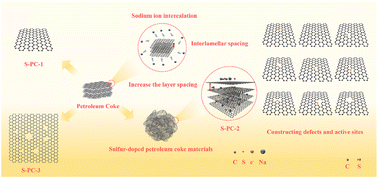
The practical application of carbon anode materials in sodium-ion batteries is limited by their poor rate capability and cycling stability. This study reports a simple and scalable strategy for preparing high-performance sulfur-doped porous carbon anodes from low-cost petroleum coke through a low-temperature pre-sulfurization and gradient carbonization process. The optimized S-PC-2 material features a unique three-dimensional porous nanosheet structure, expanded interlayer spacing (0.376 nm), and abundant C–S–C active sites. These sulfur-doping-induced synergistic properties significantly enhance Na+ diffusion kinetics and surface-induced capacitive storage. The S-PC-2 anode delivers a reversible capacity of 423.16 mAh g−1 at 0.5 A g−1 and maintains 90.2% capacity retention after 2000 cycles. Even at a high current density of 5 A g−1, it still achieves an excellent capacity of 263.92 mAh g−1. Kinetic analysis confirms its high pseudocapacitive contribution (78.0%) and rapid Na+ diffusion ability (DNa+ = 2.626 × 10⁻¹¹ cm2 s−1). Furthermore, the full cell assembled with S-PC-2 anode and Na3V2(PO4)3 cathode demonstrates good cycling stability and rate capability. This work provides a cost-effective “sulfur doping-microstructure synergistic regulation” strategy for designing high-performance sodium-ion battery anodes, while opening a sustainable pathway for high-value utilization of petroleum coke.
 Please wait while we load your content...


