


 PLATFORM UPDATE:


Surface plasmon resonance as a breakthrough tool for characterizing the size and shape of graphene quantum dots
 a
Nunzio
Tuccitto,
a
Pascal
Boulet,
c
Liang
Liu,
d
Giuseppe
Grasso
*a
and
Philippe
Pierrat
*e
a
Nunzio
Tuccitto,
a
Pascal
Boulet,
c
Liang
Liu,
d
Giuseppe
Grasso
*a
and
Philippe
Pierrat
*e
Abstract
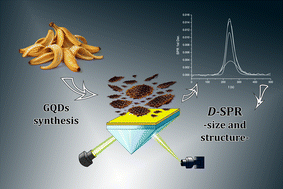
Graphene quantum dots (GQDs) exhibit size- and shape-dependent properties that critically influence their optical and electronic behavior, yet their reliable nanoscale characterization remains challenging. Here, we introduce a diffusion-based surface plasmon resonance (D-SPR) workflow that enables quantitative, shape-sensitive characterization of GQDs beyond conventional spherical approximations. Using sustainably synthesized GQDs derived from banana peels via optimized microwave-assisted methods, D-SPR resolves distinct particle populations, distinguishing monodisperse disk-like GQDs with average lateral dimensions of ≈2.5 nm from larger, polydisperse structures averaging ≈20 nm. These results are in excellent agreement with HR-TEM and DLS measurements. Crucially, unlike conventional DLS, D-SPR exploits diffusion–geometry coupling to directly identify non-spherical, disk-like GQD morphologies, supported by computational and mathematical modeling. This label-free approach delivers rapid, high-sensitivity size and shape resolution using minimal sample volumes, establishing D-SPR as a powerful complementary tool for the advanced characterization of carbon-based nanomaterials.
 Please wait while we load your content...


