


 PLATFORM UPDATE:


Advances in visible and ultraviolet self-powered photodetectors: exploring 2D materials and Janus heterostructures

Abstract
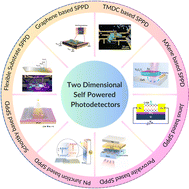
Self-powered photodetectors (SPPDs) are becoming crucial in energy-efficient optoelectronics. They operate wi.thout any external power, utilizing built-in electric fields and photovoltaic effects. Their applications range from wearable sensors to optical communication. Recent advancements in 2D materials, perovskites, Janus heterostructures, Schottky junctions, and flexible substrates have significantly improved their responsivity, broadband absorption, and mechanical flexibility. However, challenges in stability, large-scale fabrication, and charge transport efficiency remain, hindering their commercial adoption. This review critically examines the recent progress in heterostructure-based SPPDs, addressing key challenges in their device performance, material integration, and scalability. While previous researches have explored individual material platforms, gaps remain in long-term stability, interface defects, and large-area processing. This study highlights the potential of novel fabrication techniques and doping strategies to enhance the detection performance by analyzing advances in interface engineering, band alignment, and hybrid material systems. Results highlight the promise of self-driven optimization, flexible electronics, and photodetectors based on quantum materials, offering valuable insights into the future trajectory of self-powered optoelectronics. This review highlights the existing challenges and opportunities, offering insights for future advancements in high-performance, self-sustaining photodetection technologies.
- This article is part of the themed collections: Recent Review Articles and 2026 Nanoscale HOT Article Collection
 Please wait while we load your content...


