


 PLATFORM UPDATE:


Structure and mechanical properties of grain boundaries in molybdenum disulfide (MoS2)
 a
N. Scott
Bobbitt,
b
Ian S.
Winter,
b
John F.
Curry,
b
Michael
Chandross
*b
and
Fadi
Abdeljawad
*a
a
N. Scott
Bobbitt,
b
Ian S.
Winter,
b
John F.
Curry,
b
Michael
Chandross
*b
and
Fadi
Abdeljawad
*a
Abstract
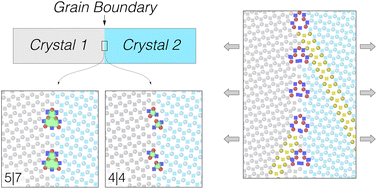
Molybdenum disulfide (MoS2) is a two-dimensional material widely used as a lubricant in many applications involving mechanical loading under a wide range of operating temperatures. Since many synthesis and processing techniques yield MoS2 in its polycrystalline form, establishing grain boundary (GB) structure–property relations is key to designing MoS2 microstructures with tailored properties. Here, we employ classical, reactive atomistic simulations to investigate the structure and mechanical behavior of a wide range of GBs in MoS2 as a function of temperature. Using a bicrystal MoS2 geometry, we characterize the atomic structure and calculate the energy of several low-angle GBs. Then, we simulate the tensile deformation behavior of MoS2 bicrystals at several temperatures. Our results reveal that at temperatures above 100 K, the deformation of MoS2 bicrystals is characterized by the nucleation of shear bands from GBs that grow, with subsequent loading, into the MoS2 crystals. At low temperatures, the tensile deformation is characterized by the nucleation and propagation of deformation fronts, resulting in altered bond angles and bond lengths. Quantitative analysis reveals a decrease in the ultimate tensile stress and ultimate failure strain of MoS2 bicrystals with the increase in temperature. Furthermore, our simulations of the mechanical behavior of metastable GBs reveal that the strength and ductility decrease with the increase in energy of these boundary structures. In broad terms, our work provides future avenues to employ GB engineering as a strategy to tailor the properties of MoS2 microstructures.
 Please wait while we load your content...


