


 PLATFORM UPDATE:


Photoinduced dynamic gelation and deformations based on molecular crystal microrods stimulated by Z-to-E photoisomerization

Abstract
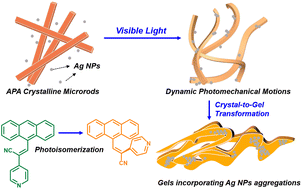
Transforming a rigid photoresponsive molecular crystal composed of anisotropic molecular packing structures into a highly disordered and soft gel using low-intensity visible light illumination is intriguing but remains a challenge. Here, we demonstrated that the slender molecular crystal microrods of an anthracene derivative (APA) rapidly (≤1 min) transform into amorphous gels, accompanied by vigorous mechanical motions, including bending, twisting, expansion, and curling, under relatively low-intensity visible light (450 nm, 20 mW cm−2) illumination. APA molecules in a highly crystalline microrod can undergo effective Z-to-E photoisomerization when exposed to visible light, causing significant molecular configuration changes to destroy the rigid crystal lattice and drive the microrod to move and deform drastically. When placed in an aqueous environment, an APA microrod rapidly (∼30 s) transforms into a gel and expands by incorporating surrounding water molecules. The resulting photoproduct gels can also engulf and gather microscopic particles, such as polystyrene microspheres, silica nanoparticles, and silver (Ag) and gold (Au) nanoparticles, due to the extensively inflated volume after gelation. As a result, the dynamic Z-to-E isomerization in the APA microrods can be in situ characterized using a microscope equipped with laser Raman spectroscopy measurements by incorporating Ag nanoparticles to amplify signals. Our research provides a facile method for achieving a rapid phase transition from a stiff material to a highly flexible state and also offers a new approach for instantaneously monitoring the dynamic photochemistry of responsive materials.
 Please wait while we load your content...


