



Control of the photoluminescence bandwidth of ZnTeSe quantum dots by suppressing the Te cluster effect

Abstract
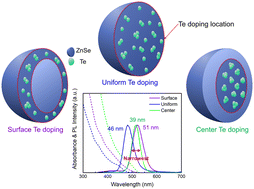
The spatial confinement of Te to the most localized location was found to be critical for achieving narrow energy transitions in ZnTeSe quantum dots. In this study, the Te cluster effect in ZnTeSe QDs was suppressed through localizing the Te dopant at the center of the QD core, producing photoluminescence (PL) at 531 nm with a bandwidth as narrow as 39 nm and a quantum yield (QY) of 89%. It was confirmed that broader emission was observed when Te was distributed over the entirety or near the surface of ZnTeSe QDs than when it was confined to the center region. This suggests that concentrating Te is beneficial for suppressing the Te clustering effect. These results highlight the importance of precise Te element positioning as a fundamental design strategy for tailoring the optical properties of alloyed ZnTeSe QDs.
 Please wait while we load your content...


