


 PLATFORM UPDATE:

Light outcoupling strategies for quantum dot light-emitting diodes
 b
and
Seong-Yong
Cho
*c
b
and
Seong-Yong
Cho
*c
Abstract
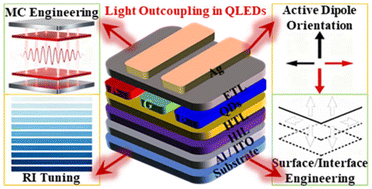
Quantum dot LEDs (QLEDs) combine exceptional colour purity, narrow emission linewidths, and tunable spectral properties, establishing them as front-runners for next-generation displays and lighting technologies. Despite significant advancements in material and device engineering, their external quantum efficiency remains intrinsically constrained by inefficient light outcoupling (LOC), with a substantial portion of emitted photons trapped by total internal reflection, waveguide confinement, and metallic absorption. These optical losses should be confronted head-on to envision a breakthrough in the suboptimal performances of the contemporary QLEDs. Herein, we launch a plethora of advanced strategies to discuss mitigative approaches for critically analysing and improving the LOC discrepancies in QLEDs. The LOC strategies, rigorously evaluated in our study, include microcavity engineering, refractive index modulation, dipole orientation control, and surface/interface engineering. Each strategy is examined in terms of its physical basis, design principles, fabrication complexities, and trade-offs in device performance. Special attention is given to enhancing light extraction while maintaining angular emission uniformity, structural stability, and scalability for large-scale manufacturing. Collectively, our LOC strategies delineate a clear roadmap toward the development of high-efficiency, commercially viable QLEDs for advanced optoelectronic applications.
- This article is part of the themed collections: Recent Review Articles and Quantum nanomaterials
 Please wait while we load your content...


