


 PLATFORM UPDATE:


Magnetic particle imaging lymphography (MPIL): a technique for lymph node mapping
 *ab
Olivia C.
Sehl,
bc
Benjamin
Fellows,
c
Chinmoy
Saayujya
d
and
Paula J.
Foster
ab
*ab
Olivia C.
Sehl,
bc
Benjamin
Fellows,
c
Chinmoy
Saayujya
d
and
Paula J.
Foster
ab
Abstract
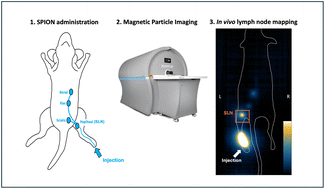
During metastasis, tumour cells drain to nearby lymph nodes, the first of which are named the sentinel lymph node(s) (SLN). SLN biopsy (SLNB) determines if metastasis has occurred. Traditionally, SLNB involves injecting a technetium-labeled tracer peritumorally, pre-operative imaging with SPECT to locate the SLN, and surgery guided by a gamma probe to remove them. Limitations include a short tracer half-life, which can make scheduling the SLNB difficult, and radiation exposure to patients and healthcare workers. Alternatively, magnetic localization, with superparamagnetic iron oxide nanoparticles (SPIONs) as the tracer and a magnetometer to detect SPIONs in the SLN during surgery, can be used; however, this lacks pre-operative imaging capability. Magnetic Particle Imaging (MPI) is an emerging imaging modality that directly detects SPIONs, holding potential for pre-operative imaging in magnetic SLNB. SPIONs for SLNB should have rapid drainage, high SLN accumulation, and high specificity to the SLN. For MPI Lymphography (MPIL), high particle sensitivity is also important. This study assesses the in vivo pharmacokinetics for SLN mapping with MPIL in a murine model, using five commercially available SPIONs of varying iron core sizes and surface coatings (VivoTrax, VivoTrax+, Synomag-D70, Synomag-D70 PEG and Synomag-D70 PEG-mannose). Our results show that the peak MPI signal measured for different SPIONs using relaxometry does not necessarily predict the MPI signal measured in vivo from images and that both the core size and the hydrodynamic size contribute to the performance of SPIONs as tracers for MPIL. VivoTrax+ had a higher peak signal measured by relaxometry (more ideal core size) but a lower MPI signal in vivo in the SLN (less accumulation in the SLN due to hydrodynamic size). Synomag-D70 had a 2.5 times higher peak signal compared to VivoTrax as measured by relaxometry, a 2–3 times higher signal in vivo in the SLN at early timepoints, and a 5–6 times higher signal in vivo at the latest timepoint. This suggests similar SLN accumulation at early timepoints and higher accumulation at the late timepoint. Synomag-D70 PEG and Synomag-D70 PEG-mannose had more rapid clearance from the injection site compared to plain Synomag. The MPI signal was detected in higher echelon nodes (HENs) for all Synomag particles, with Synomag-D70 PEG-mannose having the lowest HEN signal at 24 hours. Overall, the mannose targeted version of Synomag met more of the criteria for what is considered a good tracer for SLNB, with higher clearance, accumulation and specificity compared to the other SPIONs tested in this study.
- This article is part of the themed collection: Nanoscale Covers
 Please wait while we load your content...


