



Unprecedented polyvinyl polymer loading on SWCNTs in the liquid phase
 ab
Eleftheria
Zelou,
ab
Vikraman
Haribaskar,
b
Eftychia
Grana,
c
Nicolas
Battaglini,
b
Samia
Zrig,
b
Eric
Cloutet,
c
Benoit
Piro
b
and
Bérengère
Lebental
*a
ab
Eleftheria
Zelou,
ab
Vikraman
Haribaskar,
b
Eftychia
Grana,
c
Nicolas
Battaglini,
b
Samia
Zrig,
b
Eric
Cloutet,
c
Benoit
Piro
b
and
Bérengère
Lebental
*a
Abstract
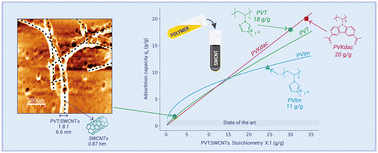
In order to reduce environmental pollution and atmospheric CO2 concentration, carbon nanotubes (CNTs) have been extensively studied in the solid phase for their ability to adsorb a wide variety of compounds. However, maximum adsorption capacities were found to be comparable to those obtained with more traditional filtration materials such as activated carbon. Conversely, the functionalization of CNTs in the liquid phase has been of great interest over the years, but with no focus on maximum adsorption capacities. The present work exploits UV-Vis spectroscopy to study the adsorption kinetics of three polyvinyl polymers, poly(1-methyl-3-vinylimidazolium iodide), poly(4-methyl-1-vinyl-1,2,4-triazolium iodide), and poly((3,6-diacetyl)-9-vinyl carbazole), on single-walled CNTs (SWCNTs) dispersed at low concentration in N-methyl-2-pyrrolidone. Exceptionally high adsorption capacities of up to 20 g of polymer per g of SWCNTs were obtained, over an order of magnitude higher than those obtained in solid phase adsorption studies. The equilibrium adsorption capacities were best modeled using Freundlich isotherms with exponents close to 1, suggesting a homogeneous adsorption process controlled by both polymer–SWCNT and polymer–polymer interactions. While many questions remain regarding the drivers of these extremely high adsorption capacities, the current results already open up a wide range of potential applications in CO2 sequestration, air purification and water remediation.
 Please wait while we load your content...


