


 PLATFORM UPDATE:


Surface dependent organometallic to covalent transition in graphdiyne molecular wires
 a
Simona
Achilli,
*be
Paolo
D'Agosta,
a
Francesco
Tumino,
a
Alessio
Orbelli Biroli,
d
Giovanni
Onida,
be
Guido
Fratesi,
be
Andrea
Li Bassi,
a
Sabine
Maier
c
and
Carlo S.
Casari
*a
a
Simona
Achilli,
*be
Paolo
D'Agosta,
a
Francesco
Tumino,
a
Alessio
Orbelli Biroli,
d
Giovanni
Onida,
be
Guido
Fratesi,
be
Andrea
Li Bassi,
a
Sabine
Maier
c
and
Carlo S.
Casari
*a
Abstract
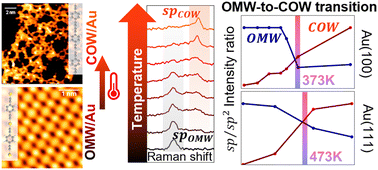
Graphdiynes are atomically thin carbon allotropes with mixed sp–sp2 hybridization, able to self-assemble into diverse 2D and 1D nanostructures, from atomic layers to nanoribbons and molecular wires, with tunable optoelectronic properties beyond those of graphene. Here, we investigate novel graphdiyne molecular wires obtained via Ullmann coupling of 1,4-bis(bromoethynyl)benzene molecules on Au(100) and Au(111) surfaces. Using scanning tunneling microscopy (STM) and low-energy electron diffraction (LEED), we track the structural evolution of these systems under increasing annealing temperatures. Exploiting Raman spectroscopy, we perform the first-ever in situ monitoring of the thermally activated transition from organometallic to covalent organic wires (OMW-to-COW), resulting in the assignment of specific Raman features to both phases supported, by density functional theory calculations. We demonstrate that surface orientation affects the Ullmann coupling efficiency, resulting in a lower OMW-to-COW transition temperature on Au(100) than on Au(111). These findings provide new insights into the temperature-dependent structural dynamics of graphdiyne molecular wires, enabling the development of more efficient on-surface synthesis processes and the design of novel functional carbon nanostructures for new-generation optoelectronic devices.
- This article is part of the themed collection: Celebrating International Women’s day 2026: Women in Nanoscience
 Please wait while we load your content...


