


 PLATFORM UPDATE:


Origins of electrostriction of MoS2 and HfS2 in 2 and 3 dimensional 1T and 2H structures

Abstract
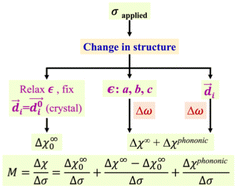
Understanding and controlling electromechanical responses of bulk and low-dimensional materials are of fundamental and technological importance. Electrostriction and piezoelectricity are two key phenomena in which mechanical strain is generated in response to electric fields, forming the basis for a wide range of electromechanical devices. The piezoelectric response is linear and symmetry-restricted, while electrostriction is a universal, second order response that occurs in all dielectrics, including centrosymmetric systems. In this work, we present a theoretical analysis of electrostrictive responses of two- and three-dimensional 1T and 2H polymorphs of TMS2 (TM = Mo and Hf), with first-principles calculations of the changes in dielectric susceptibility, χ, arising in response to applied stress. We uncover the effects of chemical composition, polymorph (structure) and dimensionality (number of layers (N) in their two-dimensional forms) on the electronic (Melec) and phononic (Mphononic) contributions to the electrostrictive response of TMS2. We find that (a) composition has a remarkable impact on the electronic part of electrostriction: Melec is positive for MoS2 and negative for HfS2; (b) the electrostrictive response depends strongly on the structure: while it is dominated by the electronic contribution in the 2H form, it is largely phononic in the 1T form; and (c) the number of layers (N) further influences the response: the phononic contribution (Mphononic) is nearly unaffected by the reduction in N, whereas the electronic contribution (Melec) decreases notably, consistent with the widening of the band gap responsible for the weakening of the electronic response. Analyzing the contributions of IR-active modes in terms of their mode effective charges  and oscillator strengths (ελ), we show that strong coupling of the soft modes in the 1T structure with the IR field plays a pivotal role in enhancing the phonon contribution to the dielectric and electrostrictive responses. Our finding that the in-plane electric field induces tensile and compressive electrostrictive strains, respectively, in monolayer MoS2 and HfS2 has important consequences for their electronic devices and heterostructures, possibly with a twist.
 Please wait while we load your content...


