


 PLATFORM UPDATE:

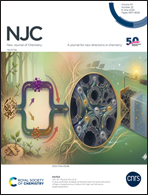
Decoding Ligand Influence in Porphyrin-Nickel Photocatalysts for Degradation of Rhodamine B
Abstract
Designing advanced materials for the efficient degradation of organic contaminants is vital as conventional methods often fall short. Porphyrins and their metal complexes with their structural adaptability, electronic tenability, tunable structures and exceptional light-harvesting properties propose a versatile platform for developing high performance photocatalysts for wastewater remediation. In this work, an organised donor-acceptor molecular engineering strategy is used to study the structure-property-performance relationship of meso-substituted porphyrins and their nickel complexes. In this regard, 5,10,15,20-Tetraphenylporphyrin (L1), 5,10,15,20-Tetrakis (3,5-Dimethoxyphenyl) porphyrin (L2), and 5,10,15,20-Tetrakis (3,5-bis (trifluoromethyl) phenyl) porphyrin (L3) and their supramolecular nanostructures nickel metalated counterparts Ni-L1, Ni-L2 and Ni-L3 were synthesised and characterised using UV-Visible spectroscopy, Nuclear Magnetic Resonance spectroscopy, photoluminescence spectroscopy, and Scanning Electron microscopy. The molecular structure comprises 3,5-dimethoxyphenyl as a donor moiety and 3,5-bis (trifluoromethyl) phenyl as an acceptor attached at the meso-position of the as-prepared complexes. The first-order rate constants followed the order Ni-L3(0.0238>> Ni-L2(0.01)> Ni-L1(0.0082)> L3(0.0065)> L2(0.005)> L1(0.0042). The obtained results disclose that photocatalytic efficacy is directed not only by metalation but also by the synergistic relationship between supramolecular aggregation, substituent electronic properties and charge-transfer behaviour. Specifically, the electron-withdrawing CF3-functionalized nickel porphyrin (Ni-L3) gives vastly ordered H-type aggregates that inhibit electron-hole recombination, promote charge delocalisation and improve visible-light-driven RhB degradation. This study thus institutes a structure-aggregation-phocatalytic activity relationship for donor-acceptor engineered porphyrin systems. A plausible mechanism for the photocatalytic activity in RhB degradation is also thoroughly discussed. This study is very important in the area of environmental remediation and provides novel prospects for designing metalated porphyrin-based photocatalytic schemes as replacements to conventional photocatalysts.
 Please wait while we load your content...


