


 PLATFORM UPDATE:


Regulation of competitive adsorption and reaction barriers for amine-based CO2 capture on metal-doped carbon nanotubes: molecular simulation and DFT study
 a
Xin
Song
*b
and
a
Xin
Song
*b
and
Abstract
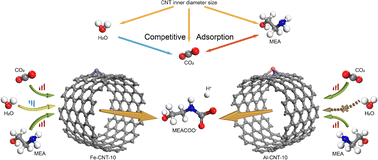
Global warming, driven by excessive CO2 emissions, urgently demands efficient CO2 capture technologies. Monoethanolamine (MEA)-based absorption is widely applied in industry but is plagued by high energy consumption, solvent loss, and strong competitive adsorption of H2O. Carbon nanotubes (CNTs) are promising modifiers; however, the effects of CNT size and metal doping on MEA–H2O systems remain unclear. Herein, grand canonical Monte Carlo (GCMC) and density functional theory (DFT) simulations were conducted to investigate the adsorption behaviors of CO2, H2O, and MEA, as well as the reaction mechanisms, on four armchair CNTs (CNT-6/8/10/15) and Fe/Al-doped CNT-10. The results indicate that CNT-10 exhibits optimal adsorption performance. Fe and Al doping significantly suppresses H2O adsorption, changes the adsorption priority to MEA > CO2 > H2O, and promotes MEA–CO2 interaction. Fe doping reduces the MEA–CO2 reaction energy barrier to 42.39 kJ mol−1, which is lower than that of Al doping (65.36 kJ mol−1). This work provides a theoretical basis for the design of high-efficiency, low-energy CNT-modified MEA CO2 capture systems.
 Please wait while we load your content...


