


 PLATFORM UPDATE:

Examining factors affecting the Schiff base post-synthetic modification of UiO-66-NH2 films by reactive inkjet printing
Pawel
Wagner  *a
and
Christopher
Richardson
*c
*a
and
Christopher
Richardson
*c
*a
and
Christopher
Richardson
*c
Abstract
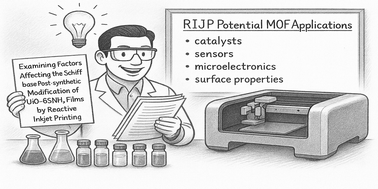
Methods to functionalise metal–organic framework (MOF) films are needed to enhance the performance of these microporous materials in applications ranging from sensors and membranes to microelectronics. Inkjet printing is a technique that offers opportunities for precise chemical functionalisation and structuring of MOF films but is yet to be adopted widely. Here, we undertake a deeper investigation of reactive inkjet printing (RIJP) for covalent functionalisation of UiO-66-NH2 films via a well-employed type of post-synthetic modification (PSM) – Schiff base formation. Our findings demonstrate the flexibility of RIJP and reveal several important considerations for MOF film PSM that will enable wide adoption in the field.
 Please wait while we load your content...


