


 PLATFORM UPDATE:


Hydrogen peroxide assisted electrooxidation of benzene to phenol over cobaltporphyrin organic frameworks

Abstract
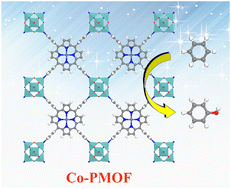
Direct electrocatalytic oxidation of benzene has been regarded as a promising approach for achieving a high-value phenol product, but remains a huge challenge. Herein, we construct a two-dimensional Lindqvist-type Mo6O19 cluster-based cobaltporphyrin organic framework (denoted as Co-PMOF) as an efficient electrocatalyst for the selective conversion of benzene to phenol via a hydrogen peroxide (H2O2)-assisted route. The well-defined hybrid framework integrates the redox-rich polyoxometalate (POM) clusters with catalytically active cobaltporphyrin units into an ordered architecture. Systematic comparison with a pristine cobaltporphyrin framework (lacking POM units) reveals that the incorporation of Mo6O19 clusters substantially enhances the catalytic performance. Density functional theory (DFT) calculations demonstrate that the Co-PMOF exhibits a lower maximum free energy change (ΔGmax) for the rate-determining step compared to its POM-free counterpart. This energetic advantage can be attributed to the synergistic interplay between the POM clusters and cobaltporphyrin centers: the POM units modulate the electronic environment of the cobalt active sites, facilitate more efficient H2O2 activation, optimize the formation of reactive oxygen species (*O species), and promote favorable phenol desorption, thereby effectively suppressing over-oxidation. This work establishes the Co-PMOF as a promising platform for mild and selective phenol electrosynthesis and underscores the potential of integrating POM clusters with porphyrin-based frameworks for the rational design of advanced catalysts for challenging C–H bond functionalization reactions.
 Please wait while we load your content...


