


 PLATFORM UPDATE:

Improving proton conductivity via crystallinity reduction and sulfonate ligand modification based on UiO-66
Abstract
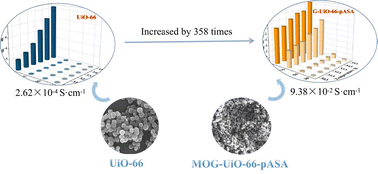
As promising candidates for novel proton conductors crucial for electrochemical energy technology, metal–organic frameworks (MOFs) have attracted much attention. The structures of MOFs have been optimized via a crystallinity reduction and sulfonate ligand modification method to improve the proton conductivity. Benzenesulfonic acid (-BSA), p-aminobenzene sulfonic acid (-pASA), and p-sulfobenzoic acid (-pSA) were used for doping in the UiO-66 reaction system. A series of UiO-66-modified target products (UiO-66-X) and the corresponding metal organic gel products (MOG-UiO-66-X; X = -BSA, -pASA or -pSA), were obtained. The proton conductivity was investigated at four different relative humidities (100%, 75%, 50%, and 30%) from 303 K to 353 K. The results showed that MOG-UiO-66-pASA had the maximum σ value of 9.38 × 10⁻² S cm−1 at 100% RH and 353 K, 358 times higher than UiO-66, which may be related to the reduced crystallinity and the –SO3H/–NH2 acid–base pairs in the structure from the doped modifying ligand -pASA. The structural attraction and repulsion effects of acids and bases on protons accelerate the transport speeds of protons in the MOG structure, thereby increasing the proton conductivity of the materials. In addition, proton-transfer mechanism studies reveal that the structural responses of the materials to variations in ambient temperature and humidity are reflected in their activation energies, prompting a transition between the Grotthuss (proton hopping) mechanism and the vehicle mechanism. This mechanistic shift ultimately influences the resulting proton conduction performance. This investigation not only proposes a simple crystallinity-reduction strategy and ligand substitution model for MOF modifications to achieve superior proton conductivity but also provides valuable insights into the adaptation mechanism between proton conduction and environmental conditions. It further offers guidance for the performance optimization of proton-conductive materials. The findings lay research foundations for the performance optimization of proton exchange membranes and the enhancement of their environmental durability in proton exchange membrane fuel cells. Compared with the crystal powder material (UiO-66) the modified gel material, MOG-UiO-66-pASA, has more coherent structural channels and –SO3H/–NH2 acid–base pairs, resulting in a 358-fold increase in proton conductivity.
 Please wait while we load your content...


