


 PLATFORM UPDATE:

A dopant-free porphyrin as a hole-transporting material enabling over 18% efficiency in perovskite solar cells
 *a
*a
Abstract
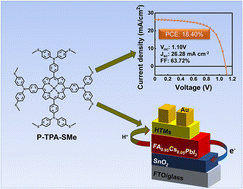
In recent years, n–i–p structured perovskite solar cells (PSCs) have witnessed significant progress, with their power conversion efficiency (PCE) soaring from 3.9% in 2013 to 24.6% in 2025. This achievement is largely attributable to the continuous optimization of hole-transporting materials (HTMs). Porphyrin-based compounds have emerged as promising HTM candidates due to their electron-rich nature. Although significantly high PCEs have been reported for porphyrin-based HTMs, opportunities for further enhancement through rational molecular design remain. In this work, we designed and synthesized a series of porphyrin-based HTMs with zinc (Zn), gallium (Ga), or copper (Cu) as the central metal, functionalized with triphenylamine groups bearing different substituents on the porphyrin core. The elevated HOMO level of the porphyrin, induced by the –OMe group, results in a non-ideal energy alignment with the perovskite. In contrast, the weaker electron-donating methylthio group (–SMe) results in a suitably lowered HOMO level, facilitating better energy level matching with the perovskite, which enhances the open-circuit voltage (Voc). Furthermore, the sulfur atom in the –SMe group acts as a soft base, forming strong coordination bonds with lead ions (a soft acid) from the perovskite at the HTM/perovskite interface. This interaction effectively passivates interfacial defects, thereby improving the photovoltaic performance of the devices.
 Please wait while we load your content...


