


 PLATFORM UPDATE:


Ion-etching-induced defect engineering toward porous Fe–N–C catalysts for efficient oxygen reduction reaction
 *a
*a
Abstract
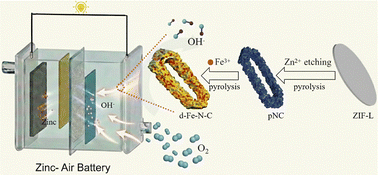
Fe–N–C catalysts are considered as the most promising candidates to replace Pt-based materials for the oxygen reduction reaction (ORR) in energy conversion devices. Defect engineering is a facile and effective strategy to boost ORR activity; however, the precise construction of defects remains challenging. Here, the ion-etching method was employed to create ZIF-derived defect-rich porous nitrogen-doped carbon (pNC) anchored Fe sites (denoted as d-Fe–N–C) as an efficient electrocatalyst for the ORR, achieving the synergistic optimization of mass transport and intrinsic activity. The catalyst d-Fe–N–C exhibited excellent ORR activity, with a half-wave potential (E1/2) of 0.91 V vs. RHE in 0.1 M KOH, surpassing that of Pt/C (0.86 V). The zinc–air batteries (ZABs) assembled with d-Fe–N–C delivered a peak power density (Pmax) of 186 mW cm−2, superior to commercial Pt/C (127 mW cm−2). This work offers new insights into the rational design of Fe–N–C catalysts using ion-etching-induced defect engineering to achieve high performance for the ORR.
 Please wait while we load your content...


