


Harnessing the synergistic dual role of lignin-derived blue carbon dots over TiO2 for highly efficient solar photocatalytic degradation of tetracycline

Abstract
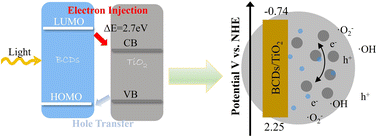
Titanium dioxide (TiO2) possesses a relatively wide bandgap, which limits its light absorption predominantly to the ultraviolet region, leading to low utilization efficiency of the broader solar spectrum. To enhance the solar energy harvesting capability of TiO2, lignin-derived blue carbon dots (BCDs) were employed as bifunctional promoters. The synthesized BCDs exhibit an average diameter of approximately 2.8 nm, abundant surface functional groups, a fluorescence lifetime of 8.56 ns, and a quantum yield of 4.96%. Compared to pristine TiO2, the BCDs/TiO2 composite demonstrates a narrowed bandgap of 2.99 eV and an extended photoresponse into the visible region up to 414 nm. Photoelectrochemical measurements further reveal that the formation of a type-II heterojunction enhances the photocurrent density from 1.0 µA cm−2 to 2.5 µA cm−2, representing a 150% improvement in charge separation efficiency. Photocatalytic evaluation shows superior performance of the composite, achieving a 98.6% degradation rate of tetracycline (TC) within 120 min, with an apparent rate constant (0.0260 min−1) approximately 16 times higher than that of pure TiO2. Furthermore, the composite exhibits excellent stability and reusability, retaining over 85.7% of its initial efficiency after five consecutive cycles. Mechanistic studies based on energy-band structure analysis and active species trapping experiments indicate that the bifunctional BCDs serve as photosensitizers to inject electrons into the conduction band of TiO2, and simultaneously form a type-II heterojunction with TiO2 to facilitate hole transfer. This synergy greatly enhances the separation efficiency of photogenerated charge carriers, with holes (h+) and superoxide radicals (˙O2−) identified as the primary active species in the TC degradation process. Analysis of the multi-pathway degradation process further confirms that the photocatalytic system follows a reactive oxygen species (ROS)-driven advanced oxidation mechanism.
 Please wait while we load your content...


