


 PLATFORM UPDATE:


A naphthalene-based and hydroxyamide-functionalized hybrid Schiff base and its dimeric and dinuclear Zn(ii) complex: synthesis, structural and theoretical characterization, and optical, DPPH scavenging and in silico ADME properties

Abstract
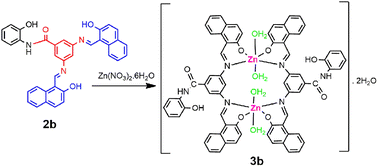
A novel hybrid ligand 2b (3,5-bis((E)-((2-hydroxynaphthalen-1-yl)methylene)amino)-N-(2-hydroxyphenyl)benzamide) was obtained from the amidation reaction between Schiff base 1b (3,5-bis((E)-((2-hydroxynaphthalen-1-yl)methylene)amino)benzoic acid) and 2-hydroxyaniline by using dicyclohexylcarbodiimide. The coordination of 2b with zinc ions resulted in the formation of a neutral dinuclear and non-electrolyte complex of 3b [Zn2L2(H2O)4]·2H2O at a stoichiometric 2 : 2 mol ratio, where each zinc(II) cation is six-coordinate in a distorted octahedral geometry with two coordinated water molecules. They were characterized by IR, NMR and UV-vis spectroscopy both experimentally and theoretically. Thermal and mass analyses provided information regarding the presence of water molecules. DFT simulations were performed to obtain the lowest-energy structures of the compounds. The calculated frontier molecular orbital gaps correlated well with the optical bandgaps. 1b–2b emitted strong greenish-blue and green emissions in dilute DMSO and DMF solutions. The emission color of 3b shifted to bluish-green/green. Their emission properties were evaluated in binary aqueous mixtures with varying water content (fw = 0–90%). Upon increasing the water fraction, the intensity was enhanced by changing the spectral profiles of the media. 1b–3b possess lower DPPH scavenging activity than ascorbic acid. The absorption, distribution, metabolism, and elimination (ADME) parameters were calculated for the ligands.
 Please wait while we load your content...


