


 PLATFORM UPDATE:


Smartphone-assisted natural rubber cryogel electrodes based on copper oxide-decorated multi-walled carbon nanotubes for on-site glucose sensing

Abstract
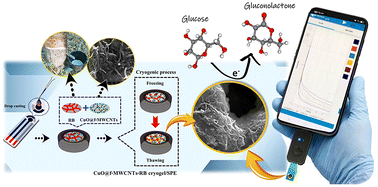
A macroporous biofilm derived from ammonia-preserved natural rubber (RB) latex served as a novel and robust supporting platform for fabricating an enzyme-free electrochemical glucose sensor. Copper oxide (CuO) nanoparticles were densely and uniformly distributed along the surface of carboxylated multi-walled carbon nanotubes (f-MWCNTs) via a mild chemical precipitation method assisted by a non-ionic surfactant micelle-mediated approach, yielding CuO@f-MWCNTs nanocomposites. These nanocomposites were embedded within the RB matrix and structured into a three-dimensional porous cryogel on screen-printed electrodes through a freezing-thawing process. The flexible macroporous RB cryogel enhanced the electroactive surface area, mass transport, and mechanical stability, thereby improving sensing performance. Chronoamperometric glucose measurements using a smartphone-assisted portable system at an applied potential of +0.40 V provided a wide linear range of 10 µM to 1.3 mM, high sensitivity of 625 ± 8 µA mM−1 cm−2, and a low detection limit of 5.0 µM (S/N = 3). The sensor showed good selectivity against common interfering species, excellent operational durability over ∼130 successive measurements, and good storage stability under ambient dry conditions. Glucose determination in the human plasma samples agreed well with the standard hexokinase method (p > 0.05). These findings highlight the potential of cryogenically structured porous RB biofilms as sustainable supporting materials that, when integrated with nanocomposites exhibiting outstanding catalytic properties, can advance the development of high-performance electrochemical sensing interfaces.
 Please wait while we load your content...


