


 PLATFORM UPDATE:


SiO2–PDA–DDTC nanocomposites for efficient and selective recovery of silver from wastewater: performance and mechanisms
 *ab
*ab
Abstract
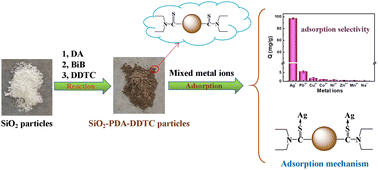
The efficient removal of Ag+ ions from wastewater is critically important from both environmental and economic perspectives, as it not only mitigates pollution but also enables sustainable recovery of a valuable precious metal. In this study, a novel functional nanocomposite (SiO2–PDA–DDTC) was synthesized and applied for the adsorption of Ag+ ions from aqueous solutions. The successfully fabricated nanocomposite was systematically confirmed by SEM, FTIR, XPS and BET analyses. Batch adsorption experiments demonstrated that SiO2–PDA–DDTC exhibited exceptional Ag+ ion removal performance, with a maximum adsorption capacity of 124.53 mg g−1 at 25 °C and pH 5. The adsorption process followed the pseudo-second-order kinetics, while the equilibrium isotherm data were best described by the Langmuir isotherm model, verifying a monolayer chemisorption mechanism. The adsorbent also exhibited excellent reusability, retaining 87% of its initial capacity after five successive adsorption–desorption cycles, along with high selectivity in multicomponent systems containing competing metal cations. XPS analysis elucidated that the C![[double bond, length as m-dash]](https://www.rsc.org/images/entities/char_e001.gif) S group in DDTC serves as the primary reactive site, enabling strong coordination interactions with Ag+ ions through electron transfer. These findings indicate that SiO2–PDA–DDTC nanoparticles are highly promising and sustainable adsorbents for selective recovery of silver from complex wastewater.
S group in DDTC serves as the primary reactive site, enabling strong coordination interactions with Ag+ ions through electron transfer. These findings indicate that SiO2–PDA–DDTC nanoparticles are highly promising and sustainable adsorbents for selective recovery of silver from complex wastewater.
 Please wait while we load your content...


