


 PLATFORM UPDATE:


PVP-regulated synthesis of Ni–Fe alloy nanoparticles anchored on N-doped graphene: enhanced kinetics and stability for ammonia borane hydrolysis
 a
a
Abstract
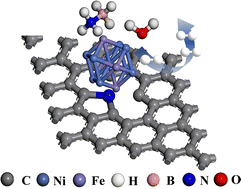
Developing cost-effective, highly catalytically active noble-metal-free catalysts for the hydrolysis dehydrogenation of ammonia borane (NH3BH3, AB) is crucial for advancing chemical hydrogen storage technology. Herein, a highly efficient catalyst composed of nickel–iron alloy nanoparticles (NPs) anchored on N-doped graphene (NG) was designed and synthesized via a surfactant-assisted solvothermal method coupled with nitridation treatment. Benefiting from the regulatory effect of polyvinylpyrrolidone (PVP), the optimized Ni3.5Fe0.5-NG-1 catalyst exhibits outstanding catalytic performance, achieving a remarkable turnover frequency (TOF) of 55.8 min−1 and a low activation energy (Ea) of 44.2 kJ mol−1 at 25 °C, coupled with robust cyclic stability. Based on experimental and theoretical investigations, the regulatory effect of PVP has been confirmed to optimize the electronic structure of the catalyst and reduce its work function. This modulation not only promotes charge transfer but also precisely tailors the adsorption energies of H2O and ammonia borane (AB) molecules, leading to a reduced energy barrier of the hydrolysis reaction. This work provides valuable mechanistic insights into surfactant-mediated structure–activity relationships, offering a viable avenue for the rational design of advanced catalysts for hydrogen energy applications.
 Please wait while we load your content...


