


 PLATFORM UPDATE:

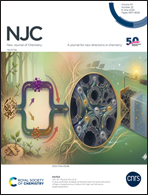
Nickel(ii)–flavonolate complexes of tetradentate 4N donor ligands as enzyme–substrate models of quercetin-2,4-dioxygenase: the effect of ligand steric and electronic properties on dioxygenolysis

Abstract
Four new flavonolate-bound nickel(II) complexes of piperidine appended tetradentate 4N donor ligands of the type [Ni(LH–LBr)(fla)]ClO41–4, where LH = 2-(piperidin-1-yl)-N,N-bis(pyridin-2-ylmethyl)ethan-1-amine, LMe = N,N-bis((6-methylpyridin-2-yl)methyl)-2-(piperidin-1-yl)ethan-1-amine, LOMe = N,N-bis((6-methoxypyridin-2-yl)methyl)-2-(piperidin-1-yl)ethan-1-amine, and LBr = N,N-bis((6-bromopyridin-2-yl)methyl)-2-(piperidin-1-yl)ethan-1-amine, have been isolated as synthetic enzyme–substrate analogues of nickel(II)-containing quercetin 2,4-dioxygenases (Ni-2,4-QDOs). The complexes were characterized by spectral, electrochemical, and thermal methods. Single-crystal X-ray diffraction analyses of adducts 1, 2 and 4 reveal distorted octahedral coordination geometries around the nickel(II) centres, consistent with the solution-state features deduced from electronic absorption and ESI-MS spectral data. The oxidation potential (Epa) of the fla−/fla˙ couple of 1–4 appears in the range +0.821 to +1.052 V (vs. SCE) in DMF. Infra-red spectral results support the existence of synergistic π-backbonding from the Ni(II)-to-O![[double bond, length as m-dash]](https://www.rsc.org/images/entities/char_e001.gif) C bond of the fla– ring. All the adducts undergo oxidative decomposition of the coordinated flavonolate moiety in O2 saturated DMF at 70 °C with a moderate rate (kobs: 1.07–7.26 × 10⁻⁴ s−1) and the reactivity is highly influenced by the steric and electronic nature of the primary ligand architecture, mimicking the function of 2,4-QDOs. The stronger Ni–Npy bonds of the unsubstituted pyridyl donors in adduct 1 enhance the π-back donation ability of the nickel(II) centre to the flavonolate ring, thereby weakening the C3C4 bond, lowering the Epa value of the fla−/fla˙ couple, and exhibiting superior 2,4-QDO reactivity. The generation of the radical intermediates fla˙ and fla-O2˙− during the reaction was indirectly confirmed with the aid of TEMPO and NBT2+ radical scavenging experiments.
C bond of the fla– ring. All the adducts undergo oxidative decomposition of the coordinated flavonolate moiety in O2 saturated DMF at 70 °C with a moderate rate (kobs: 1.07–7.26 × 10⁻⁴ s−1) and the reactivity is highly influenced by the steric and electronic nature of the primary ligand architecture, mimicking the function of 2,4-QDOs. The stronger Ni–Npy bonds of the unsubstituted pyridyl donors in adduct 1 enhance the π-back donation ability of the nickel(II) centre to the flavonolate ring, thereby weakening the C3C4 bond, lowering the Epa value of the fla−/fla˙ couple, and exhibiting superior 2,4-QDO reactivity. The generation of the radical intermediates fla˙ and fla-O2˙− during the reaction was indirectly confirmed with the aid of TEMPO and NBT2+ radical scavenging experiments.

- This article is part of the themed collection: Articles behind the 2026 journal covers
 Please wait while we load your content...


