


 PLATFORM UPDATE:


Design and evaluation of a Bi2O3/g-C3N4/NiMnO3 composite for dye degradation under simulated solar light and charge storage

Abstract
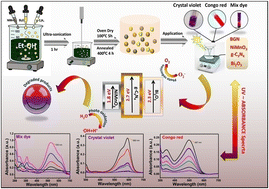
A ternary photocatalyst, Bi2O3/g-C3N4/NiMnO3, was synthesized via simple calcination, where NiMnO3 incorporation into the Bi2O3/g-C3N4 matrix formed a dual S-scheme heterojunction with g-C3N4 acting as an electron mediator between Bi2O3 and NiMnO3. This configuration enhanced charge transfer, promoted electron–hole separation, and improved redox activity, as confirmed by structural, morphological, and optical characterization. The Bi2O3/g-C3N4/NiMnO3 composite exhibited significantly improved photocatalytic activity toward the degradation of mixed organic dyes, cationic crystal violet (CV) and anionic Congo red (CR), under natural solar light irradiation. The optimized catalyst achieved approximately 99% degradation of crystal violet (CV), 94% of Congo red (CR), and 92% degradation of mixed dyes within 90 min under ambient conditions, using 40 mg of catalyst in 40 mL of dye solution at standard temperature and pressure. The pH values were adjusted to pH 7 for crystal violet (CV), pH 3 for Congo red (CR), and pH 6 for the mixed dye solution, based on the optimal stability and adsorption behaviour of the respective dyes in aqueous media. The photocatalytic degradation followed pseudo-first-order kinetics (R2 = 0.98) for the mixed dye, indicating efficient and reproducible reaction behaviour. Photoluminescence (PL) spectra confirmed the suppressed recombination of photo-induced charge carriers, consistent with the proposed dual S-scheme charge transfer mechanism. Radical scavenging identified ˙OH and ˙O2− as key reactive species, and the photocatalyst retained good stability and reusability after four cycles. Electrochemical analysis verified efficient charge transport and stable semiconducting behaviour.
 Please wait while we load your content...


