


 PLATFORM UPDATE:


Injectable self-healing hydrogels based on cation–π interactions under physiological pH conditions
 *c
*c
Abstract
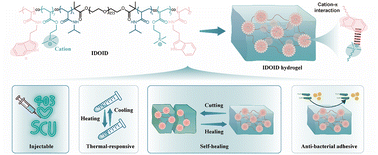
The development of self-healing hydrogels through dynamic covalent or non-covalent interactions has been extensively investigated in biomaterial research, as such materials can significantly extend their functional lifespan while enhancing safety during application. Cation–π interaction is a robust type of non-covalent bonding that holds significant biological relevance in living organisms. However, developing self-healing hydrogels based on cation–π interactions at physiological pH (7.4) is still challenging. In this work, a simple and novel strategy is proposed for fabricating injectable self-healing hydrogels under physiological pH conditions from the self-assembly of thermo-responsive ABA triblock copolymers mediated by cation–π interactions. The ABA triblock copolymer was composed of functionalized poly(N-isopropylacrylamide) (PNIPAM) incorporating quaternary ammonium cations paired with indole-containing aromatic groups, along with a hydrophilic poly(ethylene oxide) (PEO) segment. Upon thermal gelation, the cationic moieties and aromatic groups became densely packed within nanoclusters, establishing robust yet reversible cation–π interactions that conferred excellent self-healing capabilities to the hydrogels. The modulus recovery efficiency of the hydrogel after being damaged by large strain (1000%) was 99.85% in 3 min. The hydrogels also exhibited excellent thermo-responsive reversible sol–gel transition and significant shear-thinning properties with good injectable properties. In addition, the prepared hydrogels exhibited good antibacterial adhesion and cytocompatibility, demonstrating promising potential for bioengineering applications.
 Please wait while we load your content...


