


 PLATFORM UPDATE:


Nanostructured Fe2O3/SnOx heterojunction photocatalyst fabricated by co-precipitation and spin coating for efficient photoelectrochemical wastewater treatment
 *e
and
Habib
Pathan
*a
*e
and
Habib
Pathan
*a
Abstract
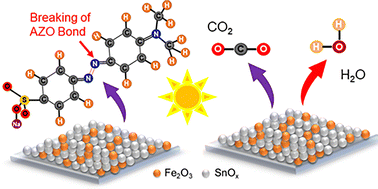
Pristine SnOx and Fe2O3/SnOx heterojunction thin films with varying Fe2O3 contents were synthesized using a simple spin-coating method for photoelectrochemical (PEC) water purification. The structural, optical, and PEC properties were systematically studied and found to be strongly influenced by Fe2O3 incorporation. XRD, Raman, and XPS analyses confirmed the formation of the heterojunction structure. Among all compositions, the 0.2 wt% Fe2O3/SnOx film exhibited optimal properties, including a dense granular morphology, a moderate band gap (3.70 eV), low charge recombination, and extended carrier lifetime. This heterojunction exhibited a longer time constant (265 ms), an average lifetime (32.8 ns), a low flat-band potential (−0.72 V), and a maximum stable photocurrent density of 1.06 mA cm−2, confirming its superior PEC performance. The heterojunction also completely degraded the methyl orange dye within 105 min under light illumination. These improvements arise from optimized band alignment, enhanced charge separation, and increased visible-light absorption, making Fe2O3/SnOx a promising photocatalyst for sustainable water purification.
 Please wait while we load your content...


