


High-strength, anti-freezing and recyclable soy protein isolate/poly(vinyl alcohol) gels empowered by a deep eutectic solvent-augmented Hofmeister effect
 *b
and
Xiancai
Jiang
*a
*b
and
Xiancai
Jiang
*a
Abstract
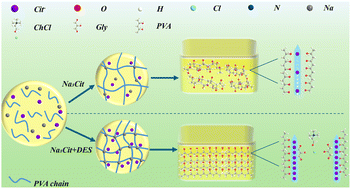
Highly tough hydrogels formed via the Hofmeister effect exhibit broad applications in flexible electronics. However, high concentrations of salting-out salts inevitably induce phase separation of the solvent and polymer chains, thereby affecting the mechanical properties and conductivity of the hydrogels. Herein, we introduced a deep eutectic solvent (DES) to suppress the strong salting-out effect of trisodium citrate (Na3Cit), thereby preventing phase separation in the soy protein isolate (SPI)/poly(vinyl alcohol) (PVA) mixture. This strategy enabled the formation of a homogeneous SPI/PVA/DES/Na3Cit composite solution, which was subsequently processed into a gel electrolyte (denoted as SPDNH) through a freeze–thaw cycle. The optimized organohydrogel exhibited a tensile strength of 1.65 ± 0.03 MPa and an elongation at break of 518.8 ± 7.49%, along with an ionic conductivity of 2.01 ± 0.04 S m−1. Moreover, the incorporation of DES imparted remarkable freeze resistance to the SPDNH, with a freezing point as low as −33 °C. A flexible all-solid-state supercapacitor was fabricated using the SPDNH electrolyte and activated carbon electrodes. The device delivered a high areal capacitance of 125.61 mF cm−2 and demonstrated stable cycling performance at room temperature, retaining 80.20% of its initial capacitance after 1000 charge–discharge cycles. Furthermore, the supercapacitor maintained reliable operation under various bending conditions and at low temperatures (−20 °C), highlighting its potential for use in flexible and low-temperature energy storage applications.
- This article is part of the themed collection: New Journal of Chemistry HOT Articles
 Please wait while we load your content...


