


 PLATFORM UPDATE:


A robust and efficient iron-based metal–organic framework for the enhanced adsorption of chlortetracycline from aqueous solutions: kinetic, thermodynamic, and mechanistic studies

Abstract
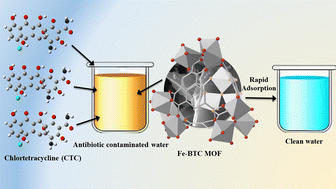
Chlortetracycline (CTC), a commonly used veterinary antibiotic, persists in aquatic environments and poses serious ecological risks. In this study, a robust and efficient iron-based metal–organic framework (Fe-MOF) was synthesized via a solvothermal method, and its performance as an adsorbent for CTC removal from water was assessed. Comprehensive characterization of Fe-MOF revealed a semi-crystalline architecture with nanoscale particles (∼18.8 nm) and abundant surface functionalities. Batch adsorption experiments were performed to investigate the influence of pH, contact time, adsorbent dosage, and initial concentration on CTC removal efficiency. Under optimized conditions (pH 7, 10 min contact time, and 0.25 g L−1 adsorbent dosage), Fe-MOF achieved 95.97% CTC removal at 200 ppb, demonstrating high efficiency even at low adsorbent loadings. The adsorption behavior of CTC on Fe-MOF followed a pseudo-second-order kinetic model and fitted well with the Freundlich isotherm, suggesting that the process was primarily driven by chemisorption and involved multilayer adsorption on a heterogeneous surface. The maximum adsorption capacity was found to be 12.34 mg g−1 at 30 °C. The thermodynamic analysis revealed that the adsorption of CTC onto Fe-MOF was a spontaneous (ΔG° < 0) and endothermic (ΔH° > 0) process. Mechanistic insights revealed that electrostatic interactions, hydrogen bonding, and π–π stacking were responsible for the strong affinity between CTC and Fe-MOF. Additionally, Fe-MOF exhibited robust reusability and structural durability over repeated adsorption–desorption cycles. These findings highlight that Fe-MOF can be used as a robust, rapid, and highly efficient adsorbent for the effective removal of CTC from water.
 Please wait while we load your content...


