


 PLATFORM UPDATE:


Synthesis, anticancer activity, and molecular docking studies of some maleimide derivatives

Abstract
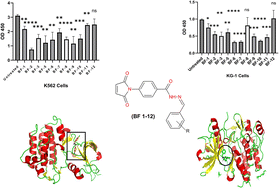
A series of 4-(2,5-dioxo-2,5-dihydro-1H-pyrrol-1-yl)-N′-[(substituted phenyl)methylidene]benzohydrazides (BF 1–12) were synthesized by reacting 4-amino-N′-[substituted phenyl methylidene]benzohydrazide with maleic anhydride in glacial acetic acid. The synthesized compounds were screened for in vitro anticancer activity against the K562 and KG-1 cancer cell lines. Most of the compounds exhibited promising anticancer potential against the K562 and KG1 cell lines. Compound BF-2 with para-chlorophenyl substitution exhibited the most potent activity against K562 cells with an IC50 value of 13.17 ± 0.07 µM. Compounds BF-6 and BF-7 demonstrated strong cytotoxic activity against KG-1 cells, displaying IC50 values of 14.85 ± 0.02 µM and 15.00 ± 0.02 µM, respectively, as compared to the standard drug doxorubicin. The structure–activity relationship (SAR) findings suggest that electron-withdrawing substituents, moderate steric bulk, and balanced lipophilicity are favorable structural features for enhancing cytotoxic activity within this compound series. Among all, BF-2 and BF-6 displayed the most favorable docking energies (−8.68 and −9.03 kcal mol−1, respectively), correlating with their superior biological performance. Compound BF-2 formed stable hydrogen bonds with Met 318 and Asp 381 in the ATP-binding site of BCR-ABL, supplemented by hydrophobic contacts with Leu 248, Val 256, and Phe 317, which are essential residues for kinase inhibition. Similarly, compound BF-6 achieved strong binding to FLT3 through multiple hydrogen bonds with Glu 692, Cys 694, and Asp 698, alongside π–π stacking with Phe 691, which stabilizes the inhibitor in the hydrophobic pocket. These findings validate that maleimide is a versatile pharmacophore for anticancer drug design.
 Please wait while we load your content...


