


 PLATFORM UPDATE:


Supramolecular architectures in the reaction products of caffeine with dihalogens: crystal structures of the CT-adduct bis(caffeine)-diiodine and the caffeinium iodine dichloride salt
 *a
Maria Carla
Aragoni,
a
Massimiliano
Arca,
a
Francesco
Demartin,
b
Alessandra
Garau,
a
Vito
Lippolis,
a
Tiziana
Pivetta
a
and
Enrico
Podda
c
*a
Maria Carla
Aragoni,
a
Massimiliano
Arca,
a
Francesco
Demartin,
b
Alessandra
Garau,
a
Vito
Lippolis,
a
Tiziana
Pivetta
a
and
Enrico
Podda
c
Abstract
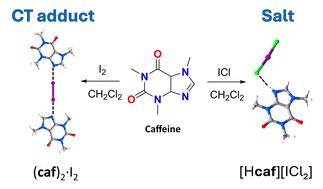
The reaction of caffeine (caf) and diiodine in CH2Cl2 under mild conditions enables the preparation of an uncommon neutral non-ionic crystalline compound (caf)2·I2. The asymmetric unit of (caf)2·I2 contains two crystallographically independent 2 : 1 adducts of the caf⋯I2⋯caf type, forming nearly linear N⋯I–I⋯N moieties. In contrast, the formation of the salt [Hcaf][ICl2], containing the caffeinium cation, was easily achieved when caffeine reacted with ICl under the same reaction conditions. The asymmetric unit of [Hcaf][ICl2] consists of a nearly planar N(9)-protonated caffeine cation that forms homomeric chains of caffeinium ions. Due to the involvement of the chlorine atoms in different packing interactions, the asymmetric [ICl2]− ions exhibit significantly different iodine–chlorine bond lengths of 2.464(3) and 2.656(3) Å. The 2D fingerprint plots indicate that the major intermolecular contacts in the crystal structure of [Hcaf][ICl2] arise from hydrogen and chlorine atoms. The MEP map of [Hcaf][ICl2] suggests that the iodine atom contributes to intermolecular interactions, in addition to the chlorine atoms. The reported structures result from the synergistic interplay of various interactions, revealing how caffeine forms different motifs, such as hydrogen bonding and π–anion contacts, which collectively determine the final assembly.
 Please wait while we load your content...


