


A high-performance fluorescent probe based on post-synthetically modified MOFs for rapid and sensitive detection of copper ions
Abstract
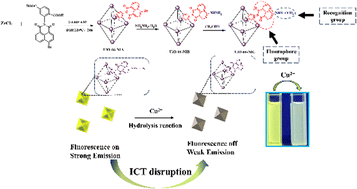
Copper ions are essential for human health but excessive intake can cause severe health issues. Fluorescence detection of copper ions typically relies on small-molecule probes, which suffer from slow reaction kinetics and low sensitivity at low concentrations. In contrast, metal–organic framework (MOF)-based fluorescent probes offer rapid response time and structural tunability, but often have low fluorescence quantum yields. This study presents a novel detection strategy using a functionalized zirconium-based MOF with naphthalimide as the luminescent moiety. A post-synthetic modification (PSM) strategy was used to graft Schiff base recognition units onto the MOF surface, which undergo specific coordination hydrolysis with copper ions, triggering fluorescence quenching. The resulting probe achieves a high fluorescence quantum yield (Φ = 36.88%) and ultra-fast response (<5 s), with a low detection limit (LOD = 0.167 µM) and excellent selectivity. The probe's broad linear detection range was successfully applied to real water samples. X-ray photoelectron spectroscopy (XPS), Gaussian theory calculations, and UV-visible absorption spectroscopy confirmed that the fluorescence quenching is mainly due to suppression of intramolecular charge transfer (ICT). This modular approach can be adapted for the rapid, sensitive detection of various pollutants using MOF-based probes.
 Please wait while we load your content...


