


 PLATFORM UPDATE:


A compositional feature-driven prediction model for the emission wavelength of Eu2+-doped whitlockite-type phosphors coupled with a material design framework
 b
b
Abstract
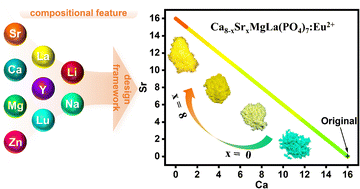
Eu2+-Doped whitlockite-type phosphors have attracted considerable attention owing to their structurally tunable frameworks and diverse luminescence colors. However, the intricate composition–property relationships present significant challenges for rational material design. In this study, a composition-based machine learning model was established to predict emission wavelengths. Through systematic evaluation of nine algorithms, the random forest regression (RFR) model was identified as the most effective, achieving a coefficient of determination (R2) of 0.817 in the independent test set. Leveraging SHAP (SHapley Additive exPlanations) analysis to interpret feature contributions, we established a data-driven material design framework for Eu2+-doped whitlockite-type phosphors. Guided by this framework, a series of Ca8-xSrxMgLa(PO4)7 (x = 0–8) solid-solution phosphors were synthesized. The experimentally measured emission peaks exhibit excellent agreement with the predicted values, with all deviations falling within a ±4% error margin. This work establishes a composition-only machine learning framework for predicting the emission properties and accelerating the rational design of complex-structured luminescent materials.
 Please wait while we load your content...


