


 PLATFORM UPDATE:


In situ ion exchange construction of Fe3C/Fe nanoparticles embedded in N-doped carbon foam for superior microwave absorption

Abstract
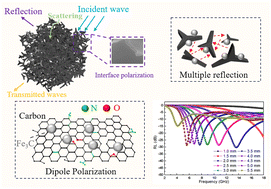
The development of high-performance electromagnetic wave absorbing materials has become crucial for addressing electromagnetic pollution. This study reports a facile in situ ion exchange strategy followed by pyrolysis for the successful preparation of N-doped porous carbon foam embedded with uniformly dispersed magnetic Fe3C/Fe nanoparticles (Fe3C/Fe@NPCF). The strong coordination between carboxyl groups on the polyamic acid (PAA) chains and Fe3+ ions effectively prevents the agglomeration of magnetic particles during high-temperature treatment and achieves their high dispersion within the carbon matrix. The effects of carbonization temperature on the microstructure, electromagnetic parameters, and microwave absorption properties were systematically investigated. The results demonstrate that the Fe3C/Fe@NPCF-800 composite exhibits exceptional microwave absorption performance with a minimum reflection loss (RLmin) of −30.19 dB at a minimal thickness of only 2.0 mm and an ultra-wide effective absorption bandwidth (EAB) of 6.48 GHz. This outstanding performance originates from the introduction of magnetic components that optimize impedance matching, allowing electromagnetic waves to be effectively attenuated. This work not only provides a high-performance absorbing material but also offers a novel design strategy and fabrication method for developing lightweight absorbers with both strong absorption capability and broad bandwidth.
 Please wait while we load your content...


