Injectable self-assembled peptide hydrogels with programmable sequences for cell culture

Abstract

This study investigates how subtle variations in amphiphilic peptide sequences and gelation strategies regulate self-assembly and hydrogel formation. Among two peptides with three crosslinking approaches, a CaCO3 and glucono-δ-lactone (GDL) slow-release method enables stable and cell-compatible hydrogels. The findings provide a rational framework for designing injectable hydrogels for biomedical applications.
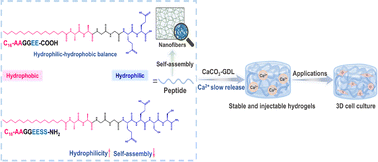
Graphical abstract: Injectable self-assembled peptide hydrogels with programmable sequences for cell culture

Supplementary files

Article information

Article type
Communication
Submitted
07 Dec 2025
Accepted
13 Feb 2026
First published
13 Feb 2026

New J. Chem., 2026, Advance Article

Injectable self-assembled peptide hydrogels with programmable sequences for cell culture

W. Hong, X. Wang, Y. Shen and Y. Wang, New J. Chem., 2026, Advance Article , DOI: 10.1039/D5NJ04725K

To request permission to reproduce material from this article, please go to the Copyright Clearance Center request page.

If you are an author contributing to an RSC publication, you do not need to request permission provided correct acknowledgement is given.

If you are the author of this article, you do not need to request permission to reproduce figures and diagrams provided correct acknowledgement is given. If you want to reproduce the whole article in a third-party publication (excluding your thesis/dissertation for which permission is not required) please go to the Copyright Clearance Center request page.

Read more about how to correctly acknowledge RSC content.

Social activity

Spotlight

Advertisements