


 PLATFORM UPDATE:

Transmetalated synthesis of homodinuclear MnII and CoII complexes containing Robson type macrocyclic ligands: crystal structure, magnetic investigation and DFT calculations
 a
and
Sasankasekhar
Mohanta
*a
a
and
Sasankasekhar
Mohanta
*a
Abstract
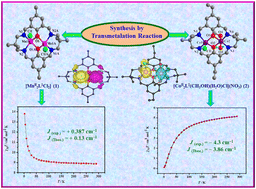
This paper presents the syntheses (through aerobic transmetalation reactions), crystal structures, magnetic properties and density functional theoretical (DFT) calculations of a dimanganese(II) compound, [MnII2L1Cl2] (1), and a dicobalt(II) compound, [CoII2L2(CH3OH)(H2O)(Cl)](NO3) (2), each containing a tetraiminodiphenol macrocyclic ligand, (L1)2− and (L2)2−, respectively, where H2L1 and H2L2 are the 2 + 2 condensation products of 4-methyl- and 4-ethyl-2,6-diformylphenol, respectively, with 2,2-dimethyl-1,3-diaminopropane. Compound 1 is formed through MnII replacing FeIII in a mononuclear precursor, whereas compound 2 is formed through CoII replacing PbII in a dinuclear precursor. The variable-temperature (2–290 K) magnetic susceptibility data at 0.1 T and variable-field (up to 7 T) magnetization data at 2 K of 1 were simulated simultaneously, yielding the parameters: J = 0.387 cm−1, g = 2.006 and zJ′ = −0.0026 cm−1. Fitting parameters for the χMT versus T data at 1 T of 2 are J = −4.3 cm−1, g = 2.484, D1 = 37.8 cm−1, D2 = 11.9 cm−1 and zJ′ = −0.91 cm−1. The corresponding J values (0.13 cm−1 for 1 and −3.86 cm−1 for 2) obtained from DFT calculations are in good agreement with the experimental values. The contrasting nature of the magnetic exchange interactions in 1 and 2 is further rationalized by DFT-calculated spin-density distributions.
 Please wait while we load your content...


