


 PLATFORM UPDATE:


Light-driven charge storage enhancement in NiSSe nanoparticles for high-performance photo-supercapacitors

Abstract
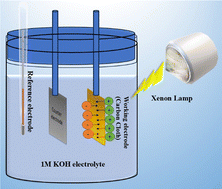
The development of light-responsive electrode materials is crucial for enhancing the efficiency of energy storage and utilization, as well as improving the performance of next-generation photo-supercapacitors (PSCs). This study examines nickel sulfide selenide (NiSSe) nanoparticles synthesized and comprehensively characterized as a promising candidate for improving photo-supercapacitors. The specific capacitances of the NiSSe photoelectrode at current densities of 1, 3, 5, and 7 A g−1 are 932.2, 818, 524, and 310.8 F g−1 under dark conditions, respectively, and significantly increase to 1028, 902, 786, and 431.2 F g−1 under light irradiation. The NiSSe electrode demonstrates a 52% enhancement in specific-capacitance at 5 mV s−1 and a 50% increase at 5 A g−1 under illumination, confirming the role of photo-induced charge carriers in improving energy storage efficiency. The material exhibits 71.38 Wh kg−1 energy density at 1 A g−1 under light, compared to 64.11 Wh kg−1 in dark conditions, with a capacitance retention of 81.35% and perfect coulombic efficiency (100%), highlighting its outstanding stability and charge reversibility. These results establish NiSSe as an efficient photoactive electrode, paving the way for innovative light-assisted supercapacitors with enhanced charge storage capabilities.
 Please wait while we load your content...


