


 PLATFORM UPDATE:


Dual applications of oil-rich coal-based carbon dots: sensitive detection of Cr(vi) and fingerprint imaging
 *a
Junxia
Cheng,
*a
*a
Junxia
Cheng,
*a
Abstract
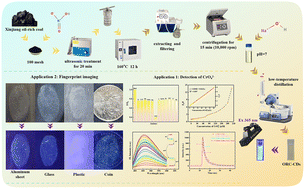
In response to the growing demand for novel materials in environmental monitoring and public safety, this study successfully synthesized fluorescent oil-rich coal-based carbon dots (ORC-CDs) via a green and facile hydrothermal route using oil-rich coal of Xinjiang as the carbon precursor. The fluorescence properties were employed as the key criterion to systematically investigate the effects of synthesis parameters, including reaction temperature, time, and nitric acid concentration. After optimization, the optimal conditions were identified as 160 °C for 12 h. The chemical structure and optical characteristics of the ORC-CDs were thoroughly characterized by Fourier transform infrared (FT-IR) spectroscopy, X-ray photoelectron spectroscopy (XPS), UV-Vis absorption spectroscopy, and fluorescence spectroscopy. In metal ion selectivity experiments, Cr(VI) exhibited a significant fluorescence quenching effect on the ORC-CD aqueous solution at specific concentrations. Additionally, the fluorescence detection capability of ORC-CDs for Cr(VI) was further tested, and the quenching mechanism of Cr(VI) in ORC-CD aqueous solution was explored. The results showed that the fluorescence response of ORC-CDs to Cr(VI) exhibited a good linear relationship within the concentration range of 0–60 µmol L−1, with a detection limit of 0.29 µmol L−1. In the spiked recovery experiment with actual water samples (tap water and river water), the spiked recovery rate ranged from 99.1% to 106.6%, confirming the accuracy of this method in actual water sample testing. Additionally, due to their excellent fluorescence properties, ORC-CDs were successfully applied to potential fingerprint imaging, quickly presenting clear fingerprint features on smooth substrate surfaces. This work provides both theoretical and experimental support for the application of coal-based carbon dot-based multifunctional fluorescence platforms in environmental monitoring and public safety.
 Please wait while we load your content...


