


 PLATFORM UPDATE:


The influence of γ-AlOOH morphology on composite separator performance for lithium-ion batteries
 *a
*a
Abstract
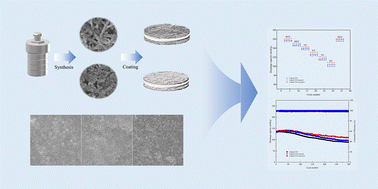
In recent years, the synthesis of inorganic materials and their morphology–property relationships have emerged as prominent research topics in the field of materials chemistry. This study employed a hydrothermal method to synthesize γ-AlOOH nanorods and nanosheets, which were subsequently coated onto Celgard 2325 separators. The effects of different morphologies of γ-AlOOH coatings on separator performance were analyzed comparatively. Compared to the Celgard 2325 separator, the γ-AlOOH-coated separator exhibited enhanced properties, with the Celgard 2325-nanorod separator demonstrating the best results, achieving an electrolyte uptake of 190.8%, a thermal shrinkage rate of only 1.7% at 160 °C, and an ionic conductivity of 0.75 mS cm−1. The assembled battery maintained a discharge specific capacity of 107.8 mA h g−1 at a rate of 5C, and after 300 cycles at 1C, the capacity retention was 79.6%, significantly outperforming the Celgard 2325 separator (66.1%) and the Celgard 2325-nanosheet separator (71.4%). These results elucidate the mechanism by which the γ-AlOOH morphology regulates the structural and electrochemical properties of composite separators, offering valuable insight for the design of next-generation, high-performance lithium-ion battery separators.
 Please wait while we load your content...


