


 PLATFORM UPDATE:


A coal-derived carbon fiber scaffold with superior mechanical robustness for ultra-stable lithium metal anodes
 *a
*a
Abstract
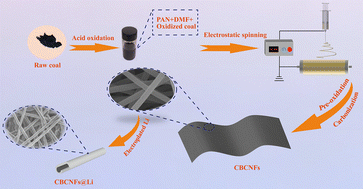
Lithium metal anodes are considered the holy grail of anode materials for next-generation high energy density lithium batteries. However, issues such as volume expansion and dendrite formation accelerate capacity fading and raise serious safety concerns, which severely hinders commercialization. Herein, coal-based carbon fibers exhibiting exceptional mechanical strength and rich oxygen-containing functional groups have been successfully synthesized, enabling the smooth deposition of lithium. The symmetrical cells fabricated with coal-based carbon fibers demonstrate remarkable cycling stability, exceeding 1800 h at 1 mA cm−2, and their stability at a lower current density of 0.5 mA cm−2 surpasses 2800 h. This property also allows corresponding half-cells to retain a 98.1% coulombic efficiency across 350 cycles. Furthermore, when paired with a LiFePO4 cathode in a full cell, this anode delivers a reversible capacity of 159.5 mAh g−1 and sustains an average coulombic efficiency of 99.8% over 300 cycles. This study thereby proposes a highly promising strategy for crafting lithium metal composite anodes that achieve extended cycle life while effectively suppressing volume expansion.
 Please wait while we load your content...


