


 PLATFORM UPDATE:

Synergistic molecular and heterojunction engineering of sulfonyl-functionalized perylene diimide polymers for enhanced visible-light photocatalysis

Abstract
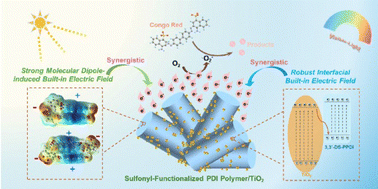
This work demonstrates a synergistic strategy combining molecular engineering and heterojunction construction to significantly enhance the visible-light photocatalytic performance of perylene diimide (PDI) polymers. Two novel sulfonyl-functionalized PDI polymers, 3,3′-DS-PPDI and 4,4′-DS-PPDI, were designed and synthesized for the first time, with the unmodified biphenyl-linked polymer 4,4′-B-PPDI for comparison. The introduced sulfonyl groups effectively broadened the visible-light absorption and, more importantly, enhanced the molecular dipole moments to facilitate intramolecular charge separation which was demonstrated based on experimental measurements and molecular simulation. In order to combine the strong molecular dipole-induced built-in electric field with an interfacial S-scheme charge transfer mechanism of sulfonyl-functionalized PDI polymers and at the same time adjust their aggregation state, a heterojunction of 3,3′-DS-PPDI with TiO2 was fabricated. Consequently, this synergy markedly improved charge separation and migration, leading to a visible-light photocatalytic degradation rate constant for Congo red of 0.462 h−1, which was 8.34 and 2.05 times higher than that of the pristine polymer and pure TiO2, respectively. This study thereby demonstrates a multilevel strategy that spans the molecular and material scales for developing high-performance organic photocatalysts.
 Please wait while we load your content...


