


 PLATFORM UPDATE:


Indigo-functionalized BODIPY, aza-BODIPY, and BOPHY systems for CYP17A1-targeted NIR bioimaging in prostate cancer
 a
and
Rajadurai Vijay
Solomon
*a
a
and
Rajadurai Vijay
Solomon
*a
Abstract
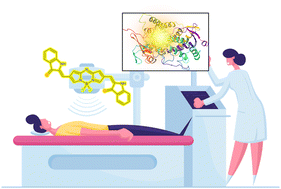
Cytochrome P450 17A1 (CYP17A1) has played a pivotal role in androgen biosynthesis and has been notably overexpressed in castration-resistant prostate cancer, thereby contributing to tumor progression and therapeutic resistance. This has highlighted the need for effective molecular tools to monitor CYP17A1 activity, particularly using organic fluorophores. In this context, BODIPY-based fluorescent probes have recently gained considerable attention due to their favorable near-infrared (NIR) optical properties for bioimaging applications. In the present study, three series of molecules, BODIPY (IB1–IB3), aza-BODIPY (IB4–IB6), and BOPHY (IB7 and IB8), have been designed by functionalizing BODIPY analogue cores with split indigo moieties and their conformations have been varied systematically to modulate their optoelectronic characteristics. Their electronic structures and optical properties have been investigated using density functional theory (DFT) and time-dependent DFT (TD-DFT) calculations. Frontier molecular orbital analysis has identified that the aza-BODIPY (IB4–IB6) series has shown the lowest HOMO–LUMO energy gap, indicative of efficient π–π* transitions and intramolecular charge transfer (ICT) characteristics. Notably, TD-DFT results have revealed that IB6 exhibits significantly red-shifted absorption and emission maxima at 1102.61 nm and 1308.71 nm, respectively. Furthermore, molecular docking studies have demonstrated that IB6, IB7, and IB8 effectively bind to the active site of CYP17A1, exhibiting more favorable docking scores (∼−12 kcal mol−1) compared to the parent molecule IB0. Molecular dynamics simulations over 100 ns have confirmed the stability of the IB–CYP17A1 complexes, supporting their potential as selective CYP17A1-targeting fluorescent probes. Overall, this study has underscored the promise of indigo-BODIPY-based biosensors as effective molecular tools for CYP17A1 imaging in prostate cancer and has laid the groundwork for future experimental validation and therapeutic exploration.
 Please wait while we load your content...


