


 PLATFORM UPDATE:


A sustainable one-pot synthesis of chiral carbon dots using response surface methodology: elucidating the mechanistic pathways through biological responses
 *ac
*ac
Abstract
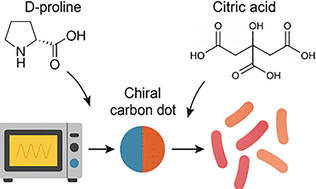
Chirality is fundamental to nature, and the distinct interactions of optically active molecules in a chiral environment are crucial for a multitude of applications. Chiral nanomaterials such as carbon dots (CDots) have attracted considerable attention due to their synthetic tunability. This tunability can be easily customized using single-step microwave-assisted techniques from relatively inexpensive and versatile molecules. Through adjusting reaction parameters, it is possible to transfer chiroptical properties from precursors to CDots while maintaining their active structure. While tunability can be achieved through bottom-up synthesis approaches, it is often time-consuming and requires multiple experiments. Herein, chiral CDots were synthesized from L-/D-proline as the chiral precursor and citric acid as the co-carbon source via a single-step microwave-assisted reaction. The duration of the synthesis, the molar ratio of chiral precursor, and the temperature of the reaction were optimized using response surface methodology-Box–Behnken design. Through active structure preservation, we were able to preserve chiral centers on the surface of CDots. CDots prepared at a temperature that preserved chirality inhibited the growth of Gram-negative and Gram-positive bacteria more efficiently than an achiral variant. Further evaluation of the mechanism of action for CDots suggested their antibiotic activities to be bactericidal, resembling the activity of polymyxin B in our study. Our findings shed light on the capacity of biological systems to discriminate between chiral and non-chiral-based CDots and can inspire new ideas in antibiotic and smart surface research.
 Please wait while we load your content...


