


 PLATFORM UPDATE:


Ferrocene-containing Schiff bases and their Sn(iv) complexes with two non-conjugated redox-active fragments: dependence of spectroscopic and redox properties on complexation and solvent
 a
Victoriya A.
Vilman,
a
Mikhail E.
Minyaev,
a
Dmitry E.
Gorbunov,
b
Nina P.
Gritsan,
b
Elena N.
Nikolaevskaya,
a
Mikhail P.
Egorov,
a
Evgeny V.
Tretyakov
*a
and
Mikhail A.
Syroeshkin
*a
a
Victoriya A.
Vilman,
a
Mikhail E.
Minyaev,
a
Dmitry E.
Gorbunov,
b
Nina P.
Gritsan,
b
Elena N.
Nikolaevskaya,
a
Mikhail P.
Egorov,
a
Evgeny V.
Tretyakov
*a
and
Mikhail A.
Syroeshkin
*a
Abstract
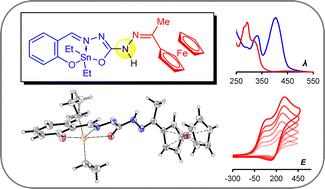
In this study, ligands and tin(IV) complexes containing two non-conjugated redox-active fragments—a Schiff base and an imino-substituted ferrocene—were synthesized and characterized using techniques, including X-ray diffraction analysis. Complexation with tin(IV) was found to induce a dramatic increase (approximately 50-fold) in absorption intensity within the visible region. In the solid state, the complexes adopt a dimeric structure stabilized by Sn–O coordination bonds between adjacent molecules. Notably, a significant proportion of the corresponding dimer persists even in highly diluted solutions, irrespective of solvent polarity. The redox properties of the synthesized compounds were investigated in aprotic media (DMF and MeCN). Reduction processes in both ligands and their tin(IV) complexes involve the Schiff-base moiety, as anticipated, given the redox inertness of ferrocene at negative potentials. In contrast, electrochemical oxidation exhibits greater complexity, with both redox-active components—the Schiff base and ferrocene. The oxidation of ligands is chemically reversible, confirming that the ferrocene unit serves as the primary redox center. In turn, the oxidation of complexes (first stage) is chemically irreversible, proceeding via the Schiff-base moiety of the monomer. The monomeric cation radicals formed during the initial oxidation undergo rapid dimerization. The resulting dimers are further oxidized at more positive potentials, producing a reversible wave attributable to electron transfer from the ferrocene units. Density functional theory (DFT) calculations corroborate these findings, confirming electron transfer from the ferrocene moiety during ligand oxidation and electron transfer from the Schiff base during oxidation of the monomeric complexes.
 Please wait while we load your content...


