


 PLATFORM UPDATE:


One-step microwave synthesis of boron-doped BiOBr/rGO nanohybrids with enhanced visible-light photocatalytic and antibacterial performance
 b
and
Shalina Begum
Tharayil
*a
b
and
Shalina Begum
Tharayil
*a
Abstract
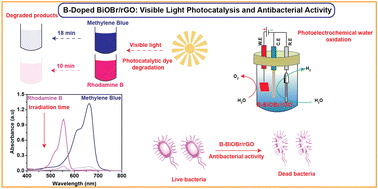
This study reports a novel visible-light-responsive photocatalyst, boron-doped BiOBr anchored on reduced graphene oxide (B-BiOBr/rGO), synthesized via a facile microwave-assisted method. Structural and physicochemical characterization using XRD, Raman spectroscopy, FESEM–EDS, TEM, XPS, and PL analyses confirms its high crystallinity, uniform dispersion, and optimized surface composition. Time-resolved photoluminescence (TRPL) measurements indicate significantly suppressed charge recombination in the nanocomposite due to the synergistic effects of boron doping and rGO incorporation. The material exhibits a reduced bandgap, enhanced visible-light absorption, and n-type semiconductor behavior with a flat band potential of −0.71 eV. Additionally, a high photocurrent density (3.475 mA cm−2), large surface area (19.78 m2 g−1), and considerable pore volume (0.321 cm3 g−1) facilitate efficient charge transport and pollutant adsorption. Under optimized conditions (pH 7.5, 7.5 mg catalyst dosage, and 5 mg L−1 dye concentration), B-BiOBr/rGO achieves rapid degradation of methylene blue (94.5% in 16 min) and rhodamine B (94.2% in 10 min), with mineralization efficiencies of 82.70% and 87.98%, respectively. LC-MS analysis elucidates degradation pathways, while ESR confirms the generation of hydroxyl (˙OH) and superoxide (˙O2−) radicals. ICP-MS results verify catalyst stability with negligible leaching. The nanocomposite also exhibits strong antimicrobial activity against both Gram-positive and Gram-negative bacteria, particularly Vibrio cholerae. Reusability tests demonstrate excellent stability over four cycles, highlighting the potential of B-BiOBr/rGO for wastewater treatment and antimicrobial applications.
 Please wait while we load your content...


