


 PLATFORM UPDATE:


Janus Mn2OS monolayers with piezoelectric altermagnetism and their application in photocatalytic water splitting

Abstract
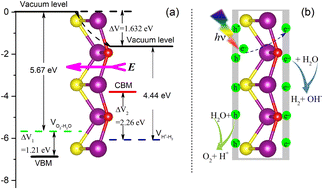
Janus monolayers exhibit versatility due to structural symmetry breaks. Using a first-principles design approach, we construct a Janus monolayer of Mn2OS, which crystallizes in the P4mm space group (No. 99) with broken spatial inversion symmetry. The constructed Mn2OS monolayer was identified as an altermagnetic semiconductor with good energetic, dynamical, and mechanical stability. It exhibits zero net magnetization but shows momentum-dependent spin-splitting. The estimated Néel temperature (TN) surpasses room temperature. Strikingly, unidirectional magnetic anisotropy was rarely observed in a two-dimensional altermagnetic single crystal with a magnetic anisotropy energy (MAE) of 215 µeV per Mn. Horizontal mirror symmetry breaking results in an inherent electric field and piezoelectricity, with an out-of-plane piezoelectric coefficient of e31 of −4.1 pC m−1 and d31 of −0.074 pm V−1. These results demonstrate the high potential of the Janus monolayer for applications in spintronics and piezoelectrics. Furthermore, the absorption spectra reveal that the monolayer exhibits outstanding optical absorption across the entire visible spectrum. The alignment of the CBM and VBM energies with the redox potentials of water indicates that Mn2OS has the potential to be used as a photocatalyst in water splitting reactions.
 Please wait while we load your content...


