


 PLATFORM UPDATE:


From atomic structure to functional properties: orthorhombic disphenoidal NaAlBr4 as a solid-state electrolyte
 a
Narciso Antonio Villar
Goris,
b
J. R.
Fernandez-Gamboa,
c
Duc Toan
Truong,
de
Chi M.
Phan
f
and
Minh Tho
Nguyen
*g
a
Narciso Antonio Villar
Goris,
b
J. R.
Fernandez-Gamboa,
c
Duc Toan
Truong,
de
Chi M.
Phan
f
and
Minh Tho
Nguyen
*g
Abstract
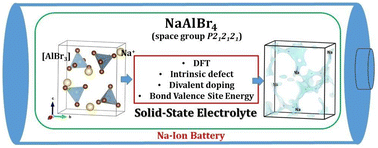
This paper presents a comprehensive computational investigation of the orthorhombic P212121 phase of NaAlBr4 as a halide-based solid-state electrolyte for sodium-ion batteries. Symmetry lowering from the conventional Pnma phase generates one-dimensional Na+ conduction ribbons along the b-axis, enabling highly directional transport. Thermodynamic stability, confirmed through computed decomposition energies, global instability index values, and convex-hull analysis, demonstrates its strong bonding, resistance to elemental breakdown and intrinsic synthesizability. Mechanical analysis reveals moderate elastic anisotropy and high compressibility, supporting interface compatibility. Electronic structure calculations show a wide band gap (4.3–4.7 eV) which corresponds to an electrochemical stability window of 0–4.5 V, ensuring an insulating behaviour and a compatibility with Na metal anodes and high-voltage cathodes. Defect energetics identify NaBr Schottky and Na+ Frenkel defects as the most favourable intrinsic configurations, while Li+ substitution and divalent doping with Zn2+ and Mg2+ at Na+ sites further promote vacancy formation. Transport analysis, evaluated by bond valence computations, yields exceptionally low migration barriers (∼0.10 eV) and room-temperature conductivities of up to 0.11 S cm−1. Although the orthorhombic P212121 phase of NaAlBr4 has not been observed experimentally yet, these results predict the P212121 phase of NaAlBr4 as a symmetry-enabled, defect-tunable halide electrolyte, advancing design strategies for next-generation sodium-ion batteries.
 Please wait while we load your content...


