


 PLATFORM UPDATE:


The promotion effect of n–π* transition in carbon nitride modified by trace amounts of benzimidazole enhances photodegradation of Rhodamine B
 *a
*a
Abstract
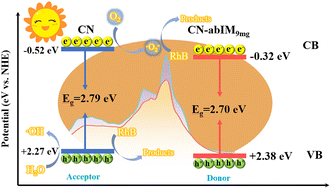
Conventional graphitic carbon nitride (g-C3N4) suffers from rapid complexation of photogenerated charge carriers and limited visible-light absorption. To address these issues, this study aims to construct an intramolecular donor–acceptor system within g-C3N4 to precisely modulate its electronic structure and enhance photocatalytic performance. A novel carbon nitride-based composite photocatalyst (CN-abIM9mg) was synthesized via a two-step thermal condensation method using 2-aminobenzimidazole (abIM) as a dopant. The ultratrace doped donor provides an electron transfer mode requiring lower energy, which narrows the band gap of g-C3N4 from 2.79 eV to 2.70 eV and expands the absorption capability to visible light. Furthermore, CN-abIM9mg has a specific surface area of 112.215 m2 g−1, which is 3.5 times higher than that of g-C3N4 (32.156 m2 g−1), supplying more photocatalytic active sites. A possible mechanism was proposed based on characterization using X-ray photoelectron spectroscopy, UV-vis diffuse reflectance spectroscopy, and density functional theory simulation calculations. In addition to the π–π* transition originating from the pristine g-C3N4, the occurrence of n–π* electronic transition within the donor–acceptor system enhanced the delocalization ability of the photogenerated charge carriers. The synergistic effects of improved light absorption, efficient charge separation, and increased surface area endow CN-abIM9mg with high photocatalytic activity, leading to a 98.8% degradation rate for Rhodamine B under visible light, with a reaction rate constant 4.9 times that of pure g-C3N4. This work provides profound molecular-level insights into enhancing photocatalytic activity through n–π* transition promotion in donor–acceptor-structured polymers.
 Please wait while we load your content...


