


 PLATFORM UPDATE:


A quantum mechanical study of compound I (Cpd I) of microperoxidase-5 (MP5) and its reactivity toward styrene
 †ab
Sadika
Nomani,
†a
Suresh
Kumar,
c
Manish
Kumar,
a
Devendra
Singh
*a
and
Devesh
Kumar
*a
†ab
Sadika
Nomani,
†a
Suresh
Kumar,
c
Manish
Kumar,
a
Devendra
Singh
*a
and
Devesh
Kumar
*a
Abstract
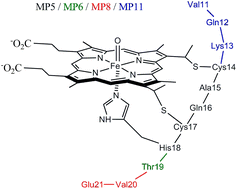
The reactivity of microperoxidase-5 (MP5) and, in particular, the substrate oxidation mechanism of its compound I (Cpd I) are still not fully understood. The mechanism by which MP5 oxidizes styrene remains unclear even though resolving this is important for interpreting MP-based biomimetic catalysis and comparing it with cytochrome P450 chemistry. Compound I (Cpd I) of microperoxidase-5 (MP5) was modeled, and the mechanisms of styrene epoxidation were investigated using hybrid density functional theory (DFT). Electronic structure analysis revealed that the lowest doublet and quartet spin states are nearly degenerate, indicating that both spin configurations are energetically accessible. In these states, two unpaired electrons are primarily localized on the Fe![[double bond, length as m-dash]](https://www.rsc.org/images/entities/char_e001.gif) O fragment, reflecting the high-spin character of the iron-oxo unit, while a third unpaired electron is delocalized over the porphyrin π-system. This porphyrin-centered electron predominantly occupies the a2u orbital, with a smaller but notable contribution from the a1u orbital, suggesting partial delocalization and mixing of the electronic density. Such distribution of spin density is critical as it influences both the reactivity of the iron-oxo center and the role of the porphyrin in mediating electron transfer during the epoxidation reaction. This electronic configuration gives rise to multistate reactivity (MSR), where both doublet and quartet spin manifolds participate and distinct electromeric forms, including carbon radicals, carbocations, and iron(III)/iron(IV) oxidation states, play mechanistic roles. The reaction proceeds through state-specific pathways that dictate product distribution. Low-spin channels lead to epoxide formation. The high-spin cationic intermediate (42cat,z2) undergoes barrierless ring closure, which also yields epoxide. In contrast, high-spin radical intermediates display different behaviors: 42-IV has a moderate ring-closure barrier, enabling rearrangements that produce mainly epoxide with some phenylacetaldehyde, while 42-III exhibits a substantial barrier, prolonging its lifetime and favoring phenylacetaldehyde and other side products. These findings provide detailed insights into the interplay between spin states, electronic structure, and reactivity in MP5 and demonstrate that microperoxidases serve as robust models for understanding the mechanistic principles of cytochrome P450-catalyzed oxidations.
O fragment, reflecting the high-spin character of the iron-oxo unit, while a third unpaired electron is delocalized over the porphyrin π-system. This porphyrin-centered electron predominantly occupies the a2u orbital, with a smaller but notable contribution from the a1u orbital, suggesting partial delocalization and mixing of the electronic density. Such distribution of spin density is critical as it influences both the reactivity of the iron-oxo center and the role of the porphyrin in mediating electron transfer during the epoxidation reaction. This electronic configuration gives rise to multistate reactivity (MSR), where both doublet and quartet spin manifolds participate and distinct electromeric forms, including carbon radicals, carbocations, and iron(III)/iron(IV) oxidation states, play mechanistic roles. The reaction proceeds through state-specific pathways that dictate product distribution. Low-spin channels lead to epoxide formation. The high-spin cationic intermediate (42cat,z2) undergoes barrierless ring closure, which also yields epoxide. In contrast, high-spin radical intermediates display different behaviors: 42-IV has a moderate ring-closure barrier, enabling rearrangements that produce mainly epoxide with some phenylacetaldehyde, while 42-III exhibits a substantial barrier, prolonging its lifetime and favoring phenylacetaldehyde and other side products. These findings provide detailed insights into the interplay between spin states, electronic structure, and reactivity in MP5 and demonstrate that microperoxidases serve as robust models for understanding the mechanistic principles of cytochrome P450-catalyzed oxidations.
 Please wait while we load your content...


