


 PLATFORM UPDATE:


Supramolecular networks of picrate derivatives with tunable hydrogen-bonding densities for selective bacterial killing

Abstract
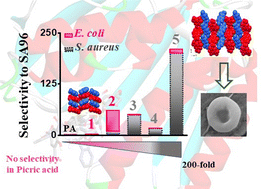
To address the worldwide challenge of antimicrobial resistance by bacterial pathogens, a series of substituted anilines/acid hydrazides crystallized with picric acid (HPA) were synthesized and structurally characterized: [An+–PA−] (1), [OAP+–PA−] (2), [OMe+–PA−] (3) and [CBH+–PA−] (5) (where An: aniline, OAP: o-aminophenol, OMe: 4-methoxyaniline, and CBH: 4-chlorobenzhydrazide). X-ray crystallographic analysis shows the asymmetric unit for each compound as supramolecular 1/2-dimensional networks for 1–3 and a 3-dimensional architecture for 5, stabilized by hydrogen bonding and charge transfer. On the other hand, the association of picric acid with 4-nitroaniline (NA), [(HPA)2–NA] (4), leads to a herringbone arrangement ruled by π–π stacking. Systematic evaluation of the broad-spectrum antibacterial activity against Staphylococcus aureus and Escherichia coli established a significant structure-function correlation in their minimum inhibitory concentration (MIC) dependences, zone of inhibition, crystal violet staining and morphological analysis. Comparative FE-SEM profiles show prominent damage to the peptidoglycan layer in the Gram-positive cell wall, while moderate blebbing was seen in the Gram-negative outermost membranes upon a 24-h treatment with 5. Molecular docking proves a DNA gyrase B-inhibiting pathway for killing bacterial cells, with the active site being the ATP binding pocket. Docking scores indicate the most favorable protein–ligand interaction for 5 (−10.02 kcal mol−1) involving Arg144 and Glu58 as the key residues. All results indicate 4-chlorobenzhydrazinium picrate (5) as a lead compound for antibacterial drug development (MIC = 1 µg mL−1) with a 200-fold selectivity index for S. aureus-mediated infections. This is attributed to the higher hydrogen-bond density in the supramolecular network of 5, aided by the acyl oxygen.
- This article is part of the themed collection: Articles behind the 2026 journal covers
 Please wait while we load your content...


